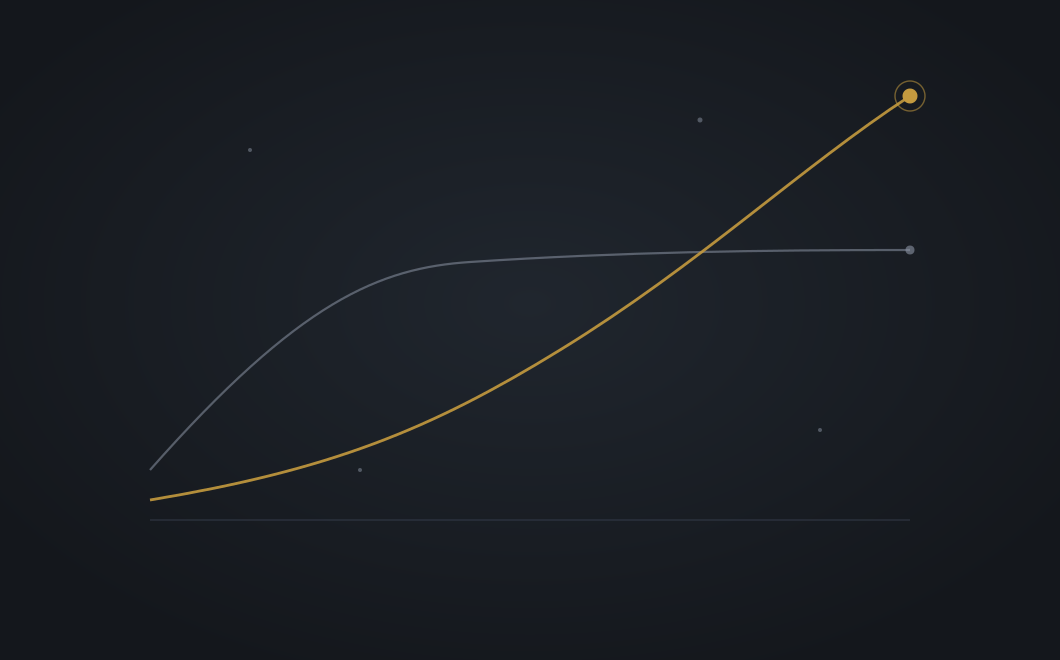
The tool keeps getting better. Your results with it stopped getting better months ago. That gap is not about the model — it is about what accumulates between your sessions, and whether anything does.
The plateau you have already hit
It is month six. The model is objectively better than the one you started with — faster, longer context, a new version every few weeks. And yet the work you get out of it looks about the same as it did in month two.
You have lived this. The first weeks with a capable AI tool are a genuine jump: things that took an afternoon take twenty minutes. Then the curve bends. You are still productive, but you are not more productive than last month. You upgrade to the newest model expecting the old jump and get a nudge. You start to suspect the ceiling is just where AI tops out.
It is not the ceiling. It is that nothing you learned in month two is still working for you in month six. Every session started from roughly the same place — a smart tool with no memory of the last time you were smart together.
Why it flattens — and why fighting it harder doesn’t help
The plateau has an honest cause, and most of the ways people fight it make the tool sharper without making the trajectory steeper.
You write better prompts. That raises the floor of any single session — and resets to zero the next one. You paste in more context. That reconstructs the last conversation, at the cost of re-reading it every time. You wait for the next model. That is real, but it is someone else’s compounding, not yours — you are renting their progress on a monthly cycle.
Notice what none of these do: carry anything forward. The mistake you caught on Tuesday, you catch again on Friday. The convention you settled on last month, you re-litigate this month because the tool never knew it was settled. The clever decomposition that finally cracked a hard problem evaporates when the tab closes. You are not building a working relationship with a system that gets better at your work — you are re-onboarding a brilliant stranger every morning.
That is the distinction the whole piece turns on. Snapshot capability is how good the tool is on a given day. Trajectory is whether your capability with it rises over months. The industry sells snapshot — a better model, this week — because snapshot is what a vendor can ship. Trajectory is what you have to build, and almost nobody tells you that you have to.
The turn: make the discipline compound instead of you
The framework I have been building — al-Nizam, Arabic for the order, the system, the discipline — is not a better prompt or a smarter model. It sits around whatever model you use and does one structural thing: it makes every session deposit something the next session can stand on.
The two trajectories that come out of that choice look like this:

The mechanism is mundane, which is the point. Nothing here is invented — it is files, git, and a protocol, primitives that have existed for decades. What is missing from the default way people use AI is not the primitive; it is the discipline of using it.
Concretely: every correction, every settled convention, every hard-won decomposition is written to a small file the moment it happens — not a chat log, a deliberate artifact. The next session loads them. So the tool does not re-learn; it resumes from the accumulated state. Here is the shape of that memory on disk:
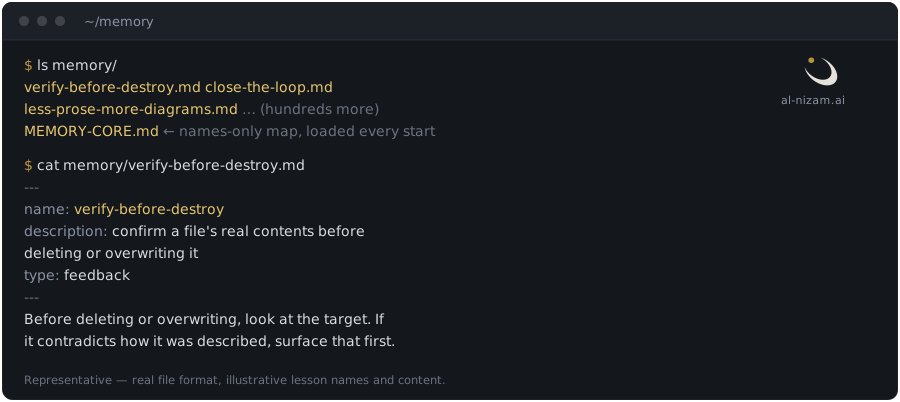
Each file is thirty seconds of a lesson learned the hard way, once — and now loaded at the start of every session, forever. Multiply it by a few hundred and you have a collaborator that is measurably less naive this month than last — the opposite of the brilliant-stranger reset.
Set the two ways of working side by side and the divergence is not subtle:
| Dimension | Raw AI use — snapshot | Disciplined framework — trajectory |
|---|---|---|
| First month | Big, visible boost | Slower — you are building the substrate, not just output |
| A caught mistake | Re-learned the next time it bites | Codified once; enforced every session after |
| A settled convention | Re-litigated when context is lost | Held in a file the tool cannot forget |
| Breadth | New capability each session, built ad-hoc | New capability composes from what already exists |
| Consistency | Degrades as sessions lose the thread | Structurally held across sessions and machines |
| At month six | Plateau; model upgrades give diminishing returns | Compounds; each session starts from a richer base |
What compounding looks like in a single day
The macro curve in Figure 1 is made of ordinary days. Here is one representative working session, counted honestly:
| One representative working session | Output |
|---|---|
| Distinct thread-shifts handled | 20+ |
| Threads dropped | 0 |
| Reusable disciplines codified (now permanent) | 2 |
| New capability arcs queued with context | 5 |
| Capabilities shipped | 2 |
| Cross-machine handoffs, no context lost | 1 |
| Operator corrections folded back into canon | 5+ |
| Commits | ~10 |
Compare that to the pre-framework version of the same day — the one many readers are living now: the context window fills and you start over; the threads you did not personally hold are gone by tomorrow; the discipline you exercised lived only in your head and transferred to no one, not even to your own next session. Same effort. Nothing compounds.
The principle
Capability compounds when the discipline lives outside your head. If you want your work with AI to get better over months — not just your tool — the move is not a better prompt and not the next model. It is to make each session deposit its lessons, decisions, and state into something durable the tool reads back at the start of the next one. Then you are buying capability, not renting it.
That principle is portable even if you never adopt al-Nizam. A single decisions file and the habit of writing to it will out-compound a year of prompt-tuning. The framework is what I built by taking the same move seriously across many disciplines, many machines, and several years.
The calibration — what the number is and is not
Living both sides of this, I would put the rise in the breadth, depth, consistency, and speed of what I can build at roughly a thousand-fold since before the framework existed.
Now let me take that number’s certainty away. It is not a benchmark. There is no lab harness behind it — it is an order-of-magnitude estimate from someone who remembers the frustration of the before and works inside the after every day. The honest, testable claim is not the digit. It is the shape of Figure 1’s gold curve: compounding, not flat. Hold me to the shape.
And it costs something. The gold curve starts below the grey one — the first weeks buy substrate instead of visible output, which is exactly why the disciplined path is a harder initial sell than the snapshot boost. The compounding is also conditional: the framework cannot save a discipline you never deposit. Skip the close-out that writes state to disk and that session compounds nothing — the substrate only holds what you actually put in it. Some of what makes this work is shipped and running daily (the file-based memory, the resume/close protocols, cross-machine continuity); other parts are scaffolded or still aspirational, and I would rather say so than show a roadmap as a fact.
None of that changes the direction of the two curves. It just means the gold one is earned, not free.
The reframe
Most AI advice optimizes the snapshot — the best model, the best prompt, today. It is not wrong; it is just the flat curve. The question worth asking is not how good is the tool this week, but is my work with it better this month than last, and will it be better again next month.
The tool is the engine, and engines keep getting better on their own. The trajectory is the vehicle you build around it. You cannot get somewhere on an engine. You get there on what you built around it — and what you built is the only part that compounds.
Second in a series introducing al-Nizam. The first piece — “AI forgets everything the moment I close the tab” — is the mechanism this one measures over time: the same file-based continuity, watched across months instead of across a single overnight.