A green test suite tells you the code agrees with the test. It does not tell you the code agrees with reality. When the same person wrote both, those are not the same statement — and the gap between them is where the confident, fully-tested, completely-broken deploy lives.
The deploy that passed everything
I shipped a change with ten of ten tests green and a clean end-to-end run in a sandbox. It was, in production, completely inert. Not flaky — inert. The feature did nothing, every time, on the platform half my work runs on.
Here is the whole failure, because it is smaller and more embarrassing than “hallucination” or “flaky CI” would suggest. The code stored a working directory and later compared it against the current one to decide whether two things matched. On one operating system a path looks like /c/Users/…; on Windows the same location is C:\Users\…. The code assumed the first form. Real operation handed it the second. They never matched, so the code silently took its fallback path — forever.
The tests did not catch it for a reason worth sitting with: the tests built their own fixtures in the same path-form the code assumed. They minted a directory in the POSIX form, fed it to the code, and checked that the POSIX form matched the POSIX form. It did. Ten times. The suite was not testing whether the code handled reality. It was testing whether the code agreed with a fixture that shared its exact blind spot.
Why green felt like done
The seduction of a green suite is that it feels like external verification, and it is not. It is the code checked against expectations written by the same mind, often in the same hour, carrying the same assumptions. When the assumption is correct, the tests are genuinely useful. When the assumption is wrong, the tests don’t just fail to catch it — they actively certify it, because the fixture was manufactured to satisfy the buggy code’s worldview.
This is the trap under “it passed, so it works.” A test constructs a small world and asks the code to behave in it. If the test-author’s model of the real world is off in exactly the way the code’s model is off, the small world is internally consistent and externally false. Everything agrees. Nothing is verified.

The tell is that both the fixture and the assertion live inside the same file, minted by the same hand:
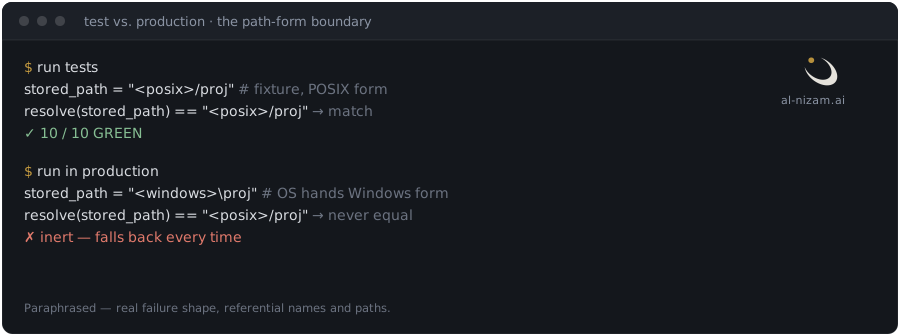
The boundary that breaks — one path-form meeting the other — is the one line the test was structured never to cross. Not from carelessness. From the ordinary fact that a fixture is a guess about reality, and this guess was wrong in the same direction as the code.
What actually caught it
Not a better test — at least, not first. What caught it was checking the live result on the real platform at the end of the session: does the resolver, running for real, actually resolve? It did not. The environment boundary — the same-location-two-forms duality between the two shells — is precisely the kind of thing fixtures paper over, because you have to be in the messy environment to see it, and a fixture’s whole job is to escape the messy environment.
That reframes the discipline. The suite is necessary and it is not sufficient. The missing step is a verification that touches reality the suite cannot manufacture: run the thing where it will actually run, on the boundary that actually bites, and look at what happens. Then — and only then — write the test that crosses the form boundary, so the regression is caught by machine next time. Reality first, fixture second.
| What a green suite proves | What it does not prove |
|---|---|
| The code matches the fixtures | The fixtures match reality |
| The assumptions are internally consistent | The assumptions are correct |
| This behavior is pinned against regression | This behavior was ever exercised on the real boundary |
| The author’s model is self-coherent | The author’s model isn’t wrong in the same way the code is |
The principle
Self-consistent is not correct. A test written by the author of the code inherits the author’s blind spots for free; when it builds its own fixtures, it can encode the very assumption the code got wrong and then certify it ten times over. So do not let green stand in for verified. For anything that crosses a real boundary — an operating system, a locale, a clock, an encoding, another team’s API — verify once against reality, in the environment that will actually run it, before you trust the suite that says it’s fine.
That principle needs no framework. It is a habit: when a change touches an environment boundary, the definition of done includes watched it work where it really runs — not the tests are green. The suite guards the second deploy. Something has to guard the first, and it can’t be the fixtures, because the fixtures are on the code’s side of the line.
What this does not claim
This is not an argument against tests, and it is not a claim that manual verification scales. Tests are how you afford not to re-verify by hand every time; the failure here was trusting them for something they structurally cannot do, not writing them at all. Manual reality-checking is the expensive, non-scalable complement you spend once, at the boundary, to earn the right to trust the cheap automated check forever after — and the honest bound is that it depends on the operator recognizing that a boundary is even present. Miss that a change touches the environment, and you’ll trust green exactly when you shouldn’t. I have no structural cure for that recognition step yet; naming it as the live risk is the most I can claim. What I can say is that the fix, once you see it, is boringly reliable: cross the boundary for real, once, then encode the crossing.
The reframe
“The tests pass” answers a narrower question than the one you’re actually asking. It says the code is consistent with what you expected. “It works” says the code is consistent with what is true. Those coincide exactly when your expectations were right — which is exactly the case where you didn’t need the reassurance. It’s the other case, the one where you were wrong in a way your fixtures shared, that a green checkmark is engineered to hide.
Trust the suite to catch what you already understand. Trust reality to show you what you don’t. Only one of them can surprise you, and it isn’t the one that’s green.
Part of a series introducing al-Nizam, an operating framework for working with AI. A companion idea from the same failure — replacing a fragile proxy for identity (a path, a time-window, a heuristic) with the real thing — is drafted separately; this piece stays on the one lesson: green is not verified.