The dangerous thing your AI does is not that it is sometimes wrong. Everything is sometimes wrong. The dangerous thing is that it is wrong in the exact same confident voice it is right — so you cannot tell, from the words alone, which sentences to trust. That is not a knowledge problem. It is a labeling problem.
The confident wrong answer
You asked it a question and it answered immediately, fluently, with a function name and a file path and a reason. All three were invented. Not maliciously — it did not know it did not know. It produced the shape of a correct answer because producing shapes is what it does, and the shape of a guess and the shape of a fact are, on the surface, identical.
This is what people mean by hallucination, and the reason it erodes trust so fast is subtle. A tool that was wrong and sounded unsure would be fine — you would go check. The problem is a tool that is wrong and sounds exactly as certain as when it is right. It hands you a fact and a fabrication in the same tone, and quietly moves the entire job of telling them apart onto you. Over enough sessions you learn to distrust everything it says, including the true parts, which is its own kind of expensive.
The industry’s answer has mostly been a better model — one that hallucinates less. That helps, and it is someone else’s progress on a monthly cycle. It also misses the point. Even a model that is wrong half as often is still wrong in the same undifferentiated voice. Halving the rate does not solve the labeling problem. It just makes the unlabeled mistakes rarer and therefore easier to miss.
Why “please be accurate” doesn’t work
Watch how people try to fix this from inside the chat, and why it slides off.
You tell it to be accurate. It agrees, and hallucinates accurately-sounding content. You tell it to say when it is unsure — and it either hedges everything into uselessness or forgets the instruction three turns later, because the instruction lived in the transcript and the transcript is shallow. You ask it to cite sources; it cites sources that do not exist, in perfect citation format. Each fix targets the manner — sound more careful — when the actual gap is structural: there is no point in the process where an unverified claim is forced to wear a different label than a verified one.
That is the move the tooling skips, because it runs against the grain of the product. A chat assistant is optimized to be fluent and helpful, and “I don’t know” reads as unhelpful. So the default posture is confident completion. The honesty you actually want — this part I checked; this part I’m inferring; this part I’m guessing, go verify — has to be imposed as a discipline the system cannot opt out of. It will not emerge from asking nicely.
The precise reframe: hallucination is not a defect of the model’s knowledge. It is the absence of a protocol that separates what the model knows from what it is producing to sound complete.
The gate: label the claim before it reaches you
So the structural answer is not a smarter model. It is a gate every claim passes through before it lands in front of the operator — one that sorts the claim into an honest label instead of letting it all leave in one voice.

In this framework that gate is a required labeling discipline, and it is boring on purpose. Any claim not directly verified from source in the current session must carry its confidence on its face:
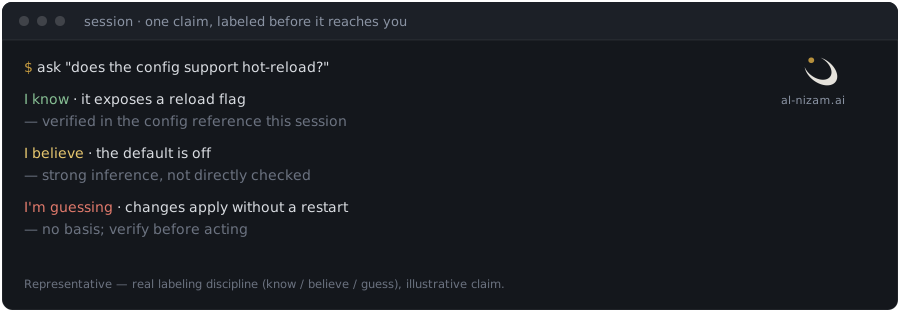
Three words, applied every time. The effect is not that the tool becomes correct — it is that its incorrectness stops hiding. A wrong “I’m guessing” costs you nothing; you were already going to check. A wrong “I know” is the expensive one, and the label is exactly what makes an unbacked “I know” a rule violation you can catch, instead of an indistinguishable sentence you can’t.
Two more layers sit on top of the same principle, and both are plain mechanism rather than personality:
- Faithful outcome reporting. If the tests failed, say so, with the output. If a step was skipped, say that. “Done” is only allowed to mean done and verified — which directly kills the most common hallucination in real work, the confident “it’s working now” over code that was never run.
- Verify before asserting a thing doesn’t exist. Before claiming a file, function, or setting isn’t there, look — the fabricated absence (“there’s no such config”) is as costly as the fabricated presence, and it comes from the same missing check.
Then, after the work, an honest reckoning: what I said I’d deliver versus what I actually delivered — declared against done, in writing. It is the same move as the confidence label, run one level up: force the system to state the gap rather than paper over it. Set the two postures side by side:
| On an unverified claim | Generic tool | Protocol-bound framework |
|---|---|---|
| How it’s stated | Same confident voice as a fact | Labeled know / believe / guess |
| ”It’s done” | May mean “it looks done” | Means done and verified, or it doesn’t say it |
| Asked for a source | May invent one in perfect format | Cites what’s checked; flags what isn’t |
| Claiming absence | ”There’s no such file” — unchecked | Looks first; absence is verified too |
| After the task | Moves on | Reckons: declared vs delivered, in writing |
The principle
Honesty is a protocol, not a personality. You will not get reliable calibration by finding a more truthful AI or by asking it to be careful. You get it by imposing a rule it cannot exit: every claim wears its confidence, “done” has to be earned, and absence gets checked like presence. Make the system say what it does not know, structurally, and the fluent-confident-wrong failure mode loses the thing that made it dangerous — its disguise.
That principle is portable with no framework at all. Add one instruction that survives your sessions — label every uncertain claim, and never report a task complete you haven’t verified — and you have converted a tool that hides its guesses into one that flags them. That single change does more for trust than a model upgrade, because it fixes the labeling, not just the rate.
What this does not claim
The gate is real and shipped and I use it every day — and here is what it is not.
It does not make the tool incapable of hallucinating. A determined wrong “I know” can still slip through; the label makes the violation catchable, not impossible. The catching still leans on a human — in practice the operator is the backstop who notices an over-confident claim and calls it, the same partnership-with-teeth that the rest of this framework runs on. Layers that would catch more of it before a human has to — a standing audit pass that checks stated-done against actually-done, continuous invariant checks that surface drift automatically — exist partly as running discipline and partly as scaffolding still being built; I will describe them as direction, not as finished machinery. And calibration has a cost: a system that refuses to sound certain when it isn’t will tell you “I’m guessing” more often than a tool engineered to please, which feels less impressive in the moment and is worth far more by Thursday.
What is unambiguously shipped is the mundane core — the confidence labels, the faithful-reporting rule, the verify-before-asserting habit, the after-action reckoning. That is enough to change the failure mode, which is the only claim I am making.
The reframe
Stop grading your AI on how confident it sounds. Confidence is the cheapest thing it produces and the least correlated with being right. Grade it on whether it will tell you, unprompted, which of its own sentences it hasn’t checked. A tool that hands you facts and guesses in one voice has handed you its job on top of your own. A tool that labels them has done the one thing that makes the rest of what it says worth trusting.
The model’s job is to be smart. The protocol’s job is to keep it honest. Only one of those is optional, and it isn’t the second one.
Part of a series introducing al-Nizam, an operating framework for working with AI. Its sibling — “Your AI apologized, then made the same mistake tomorrow” — is the same discipline pointed at corrections instead of claims: honesty that persists because it’s structural, not performed.